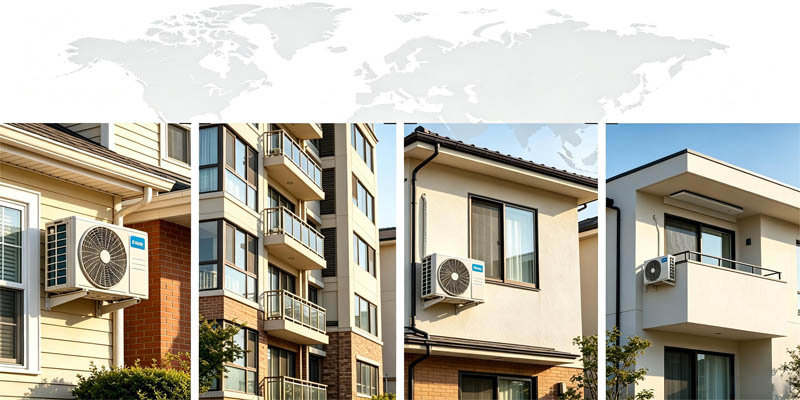
There are huge differences in the installation habit of residential air conditioners in different countries, which are mainly reflected in China’s preference for split wall mounted air conditioners and flloor standing AC units and the popularity and widespread use of central air conditioners in the United States. While in Europe, to avoid damaging walls and old buildings, prefer using mobile or small units instead.
East Asia
Equipment preferences: split air conditioners and floor standing units play the main role in the domestic home use air conditioner market. Both of which emphasize precise temperature control in a single room with the widespread adoption of cooling and heating functions.
• Installation features: extremely distant between indoor unit and outdoor unit, making it usually install back-to-back through the wall near to the window side.
North America (America / Canada)
Rely mostly on Central AC or ducted concealed units, while window air conditioners are occasionally put in use in old apartments and eco-friendly residential houses.
• Installation features: Typically, large compressors and condensers are placed on the exterior side of the house or on the ground in the backyard (pad mount), allowing hot or cold air to be delivered to each room through ducts in the floor slabs and walls. Heat pump technology has recently seen significant adoption in the US market due to environmental policies.
European (German/French/UK/Italian)
Equipment Preferences: Traditionally, natural ventilation is the primary method. In recent years, due to frequent extreme heat waves, the penetration rate of split-type air conditioners is higher in Southern Europe (Italy and Western Europe) (40%-50%), but remains low in Western and Northern Europe (the European average is only about 20%).
• Installation Characteristics: Due to restrictions imposed by historical building protection laws and housing rental regulations, installing outdoor units is particularly difficult, and in some cases, municipal or landlord consent is required. Portable air conditioners or wall-mounted units normally prevail in the market. In recent years, air-to-air heat pumps have gained popularity in Germany and Northern Europe as a replacement for conventional boilers, fulfilling the twin needs of winter heating and summer cooling.
• Regulatory Restrictions: Some countries have strict restrictions on environmentally friendly refrigerants, energy efficiency ratings (such as the EU ERP directive), and construction noise.
Middle East and tropical developing countries
• Equipment preferences: Middle Eastern countries have extremely high penetration rates (e.g., over 80% in Saudi Arabia), heavily reliant on large split-type air conditioners or heavy-duty window units, which need to operate 24/7. Split-type air conditioners are the mainstream in tropical regions (such as Southeast Asia and parts of South Asia).
• Installation characteristics: Due to extremely high outdoor temperatures (often exceeding 50°C), the outdoor units of air conditioners have extremely high requirements for high temperature resistance and corrosion resistance (coastal or dusty environments). Copper pipes must undergo high-standard insulation treatment, and the amount of condensate discharged is extremely large.
Regional climate and living customs determine air conditioner installation preferences. Insight into local habits supports targeted product development for global residential markets.
We are a professional air conditioner manufacturer; should you have any further questions, please feel free to reach us.